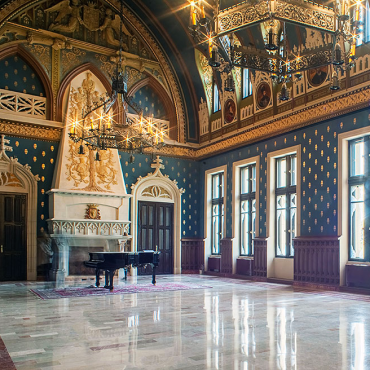
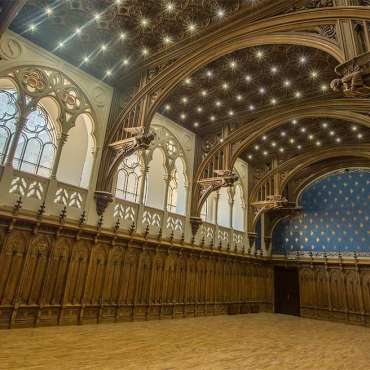
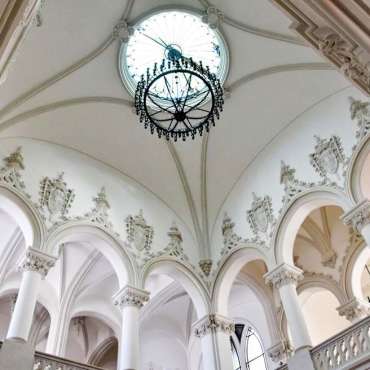
The palace in the center of Iasi, designed in the spirit of communal services in the Western, is a blend of several architectural styles: neo-gothic, romantic, neo-baroque, and it strongly influenced the architecture of the ancient capitals of the country.
The stairs to the monumental, symmetrical they are constructed of marble of Carrara marble and the wall is made up of dentils on the accolade, awarded by the eagle with shield, symbolizing the opening of the road. The marble is white, with a venatură discretion, landings are made out of mosaic tile in the pattern with tiles for the checkerboard, the same size as the ones on the first floor, but a different color (white, pink, dusty). The white tiles are made from marble, the color of the stuco marble.
The "Henri Coanda"
The entry in the "Henri Coanda" it's guarded by two slots left today with the busts of the original. They still retain the printed name of the former ministers of justice, Matei B. Cantacuzino (1855-1926), and George Mârzescu (1834-1901). The two busts were put into the backgrounds of the flesh, made up of a "patchwork of the byzantine".
Hall of Fame
The palace of Justice and the Administration of Iasi, romania, built between the years of 1906-1925 according to the plans of architect I. D. Berindey, it was required to do so by the size of his most remarkable. Thus, the central tower of the building, the touches of 55 metres high, was the Palace of the is to be considered at the time the tallest building in the city, with a footprint of a 7330 sq m and an area of 34.236, 35 sq. m.